The Cambridge Companion to F. Scott Fitzgerald by Ruth Prigozy
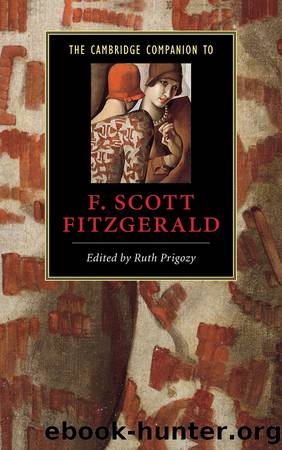
Author:Ruth Prigozy
Language: eng
Format: epub
Publisher: Cambridge University Press
Published: 2002-11-14T16:00:00+00:00
Yesterday he had been sure of these two, holding them in the hollow of his hand. As he dressed for dinner he realized that he wanted them both. It was an outrage that he couldnât have them both. Wouldnât a girl rather have half of him than all of Harry Whitby, or a whole Spic with a jar of pomade thrown in? Life was so badly arranged â better no women at all than only one woman. (300)
This interior monologue makes plain the pathetic immaturity and ultimate fear of emotional commitment that generate McLaneâs romantic âindecision,â as well as suggesting that his virulent racism operates, like his blatant sexism, to prop up a fragile ego haunted by justifiable worries about his own vacuity. As an expatriate banker and bon vivant, McLane epitomizes a crass, American insensitivity to cultural and ethnic otherness; from the moment he arrives among the âalien mountainsâ at the âDent de Something,â attired in a âconvictlike uniformâ and confused by words uttered âin some strange language,â we see him as a prisoner of his own ignorance and narcissism (292â3). Among the thoughtless Americans who flaunt their wealth, bigotry, and insouciance in Fitzgeraldâs short fiction, Tommy McLane is in a class by himself. As one of the last stories written before the Fitzgeraldsâ somber return from Europe in September 1931, âIndecisionâ reveals, in its ironic treatment of the protagonist, the authorâs development of a critical perspective on the politics and ethics of transculturation. Juxtaposed against the crudities of âHow to Live on Practically Nothing a Year,â the story reveals just how much Fitzgerald had matured as a cultural observer since 1924.
Two late expatriate pieces, composed in the United States long after the authorâs return, add little to the critique of cultural difference but place his years abroad in a poignant personal perspective. Already estranged by mental illness, the Fitzgeralds had lived apart in 1930â1 while Zeldaâs protracted hospitalization at Nyon and Scottâs rootless existence in Swiss hotels enforced a physical separation. Matthew J. Bruccoli notes that during this epoch Fitzgerald âbegan sleeping with other women,â possibly to refute Zeldaâs imputation of homosexuality (Bruccoli, Some Sort of Epic Grandeur, 311). When the couple returned to the United States, they tried to resume a semblance of marriage while both translated their wild, ultimately woeful expatriate years into novels. During her second collapse, Zelda completed Save Me the Waltz in early 1932 at the Henry Phipps Psychiatric Clinic of the Johns Hopkins University, and Fitzgerald â complaining of stolen material and indiscreet disclosures â warily supervised her revisions as he toiled to complete Tender is the Night. Yet after a precarious reconciliation, they drifted further apart, Zelda into suicidal derangement (and hospitalization at the Sheppard and Enoch Pratt Hospital) and Scott into alcoholic escapism.
By the time he wrote âThe Intimate Strangersâ (February-March 1935), Fitzgerald was rusticating in North Carolina, seeking a respite from symptoms of tuberculosis. Based ostensibly on the unconventional marriage of his friends Nora and Lefty Flynn, the story nevertheless incorporates thematic vestiges of Fitzgeraldâs years in Europe.
Download
This site does not store any files on its server. We only index and link to content provided by other sites. Please contact the content providers to delete copyright contents if any and email us, we'll remove relevant links or contents immediately.
The Fine Print (Dreamland Billionaires Book 1) by Lauren Asher(2550)
Fury of Magnus by Graham McNeill(2443)
The Last House on Needless Street by Catriona Ward(2387)
The Rose Code by Kate Quinn(2195)
A Little Life: A Novel by Hanya Yanagihara(2120)
The God of the Woods by Liz Moore(1919)
Malibu Rising by Taylor Jenkins Reid(1914)
Luster by Raven Leilani(1898)
Transcendent Kingdom by Yaa Gyasi(1853)
Moonflower Murders by Anthony Horowitz(1842)
The Lost Book of the White (The Eldest Curses) by Cassandra Clare & Wesley Chu(1688)
This Changes Everything by Unknown(1499)
The Midwife Murders by James Patterson & Richard Dilallo(1484)
The New Wilderness by Diane Cook(1439)
The Lying Life of Adults by Elena Ferrante(1430)
Wandering in Strange Lands by Morgan Jerkins(1419)
Written in the Stars by Alexandria Bellefleur(1400)
Ambition and Desire: The Dangerous Life of Josephine Bonaparte by Kate Williams(1384)
The Lying Life of Adults by Elena Ferrante;(1308)
